How to play Pickleball Doubles?
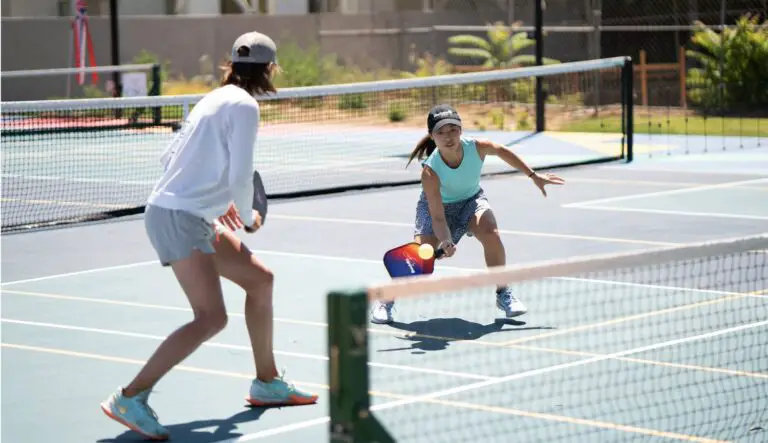
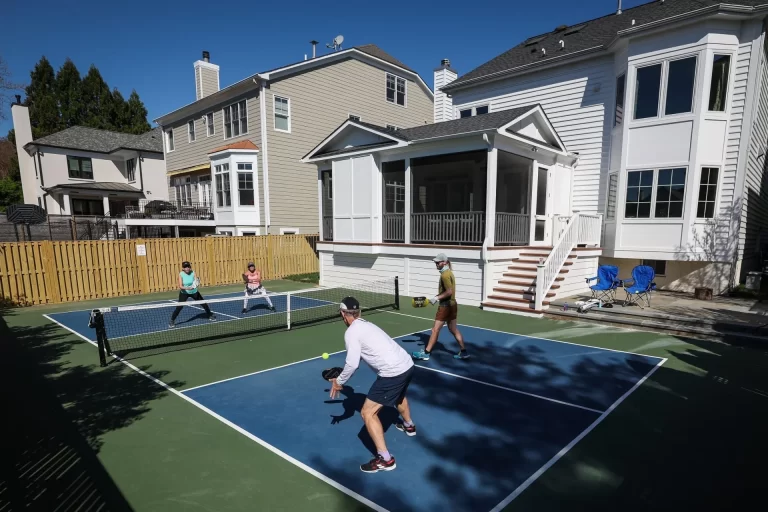
Pickleball doubles is the most popular format of the sport, where two teams of two players each compete on a standard 20′ x 44′ court. In doubles, the score is called as three numbers: the serving team’s score, the receiving team’s score, and the server number (1 or 2). For example, “5-3-2” means the serving team has 5 points, the receiving team has 3, and the second server is serving. This third number is unique to doubles and is crucial for tracking whose turn it is to serve.
To play pickleball, you need to learn some basic rules that Include diagonally serve, the court size, the net height, volley and non volley zones, double bounce rule the faults and much more.
Let’s learn how to play pickleball double in detail:
How to play Pickleball Doubles?
In tournament play or more formal settings, pickleball doubles matches are often played as a “best of three games.” The team that wins two out of three games is declared the match-winner. Understanding the pickleball doubles game procedure is crucial to enjoying the game and participating competitively. It’s essential to follow these steps to ensure a fair and enjoyable match for all players involved. In pickleball doubles, the procedure follows a set of steps to ensure that the game is played reasonably and efficiently. Here’s a summary of the typical pickleball doubles game procedure:
Coin Toss or Paddle Spin:

Before the game begins, a coin toss or paddle spin is often used to determine which team will have the option to serve or receive.
Starting Serve:
The game starts with one member of the serving team (the right-hand player) standing behind the baseline and serving the ball diagonally to the opposite service court. The receiving team stands on the other side, and the player who is diagonal from the server receives the serve.
Serve and Rally:
The serving team must let the ball that served bounce one before returning it (the two-bounce rule is not in effect for the serve). After the initial bounce, both teams engage in a rally, trying to win the point by hitting the ball over the net and into the court of the opponent.
Scoring Points:
The serving team scores points if they win a rally. The serving team’s score is always announced first, followed by the receiving team’s score. Points are gained one at a time during a rally.
Faults and Side Outs:
If the serving team commits a fault (e.g., the ball goes out of bounds, doesn’t reach the opposite service box, or the serving player steps into the non-volley zone), they lose their serve and call it side-out. The receiving team then becomes the serving team.
Winning the Game:
In a standard pickleball doubles game, the winning team is the first to reach 11 points, but variations can extend the game to 15 or 21 points. However, the game must be won by a team that is ahead by at least two points. For instance, if the score is 11-10, the game will be continued until it leads by two points, such as 12-10, or it may be 13-11.
Switching Sides:
In official pickleball matches, players switch sides of the court when the sum of both teams‘ scores equals six. This ensures fairness as external factors, like sun and wind, affect both teams equally. Side switching can occur when the score is 3-3, 5-1, or 2-4, for instance.
Game Conclusion:
The game continues with this process until one team reaches the predetermined number of points (e.g., 11, 15, or 21) and is ahead by at least two points. The first team to achieve this is declared the winner of the game.
How to get more points in Pickleball Doubles?
The primary goal is to get to the non-volley zone line (the “kitchen”) as a team. Controlling the kitchen puts you in the best position to attack. Shots hit down the middle of the court are high-percentage plays. They reduce sharp angles and force opponents to communicate, often leading to confusion and errors. The cross-court dink is a reliable tool. It travels over the lowest part of the net and pulls opponents wide, opening up the court for a winner. An advanced strategy where both players line up on the same side before the serve, then quickly move to their preferred side. This allows each player to use their stronger forehand to cover the middle.
FAQ
Can you switch sides with your partner in doubles?
Yes, you can. This is often done through a strategy called “stacking,” where players position themselves to ensure the stronger player covers the majority of the middle shots.
What is the “kitchen” in pickleball doubles?
The “kitchen” is the non-volley zone, a 7-foot area on both sides of the net where players are not allowed to hit the ball in the air (volley) while standing in it.
Can you hit a volley from the kitchen?
No. It is a fault to volley the ball while you are standing in the kitchen or if your momentum after a volley carries you into it.
How is the first server chosen in doubles?
Typically, a coin toss or a game of “Rock, Paper, Scissors” decides which team serves first. The first server of the match is then determined by that team.